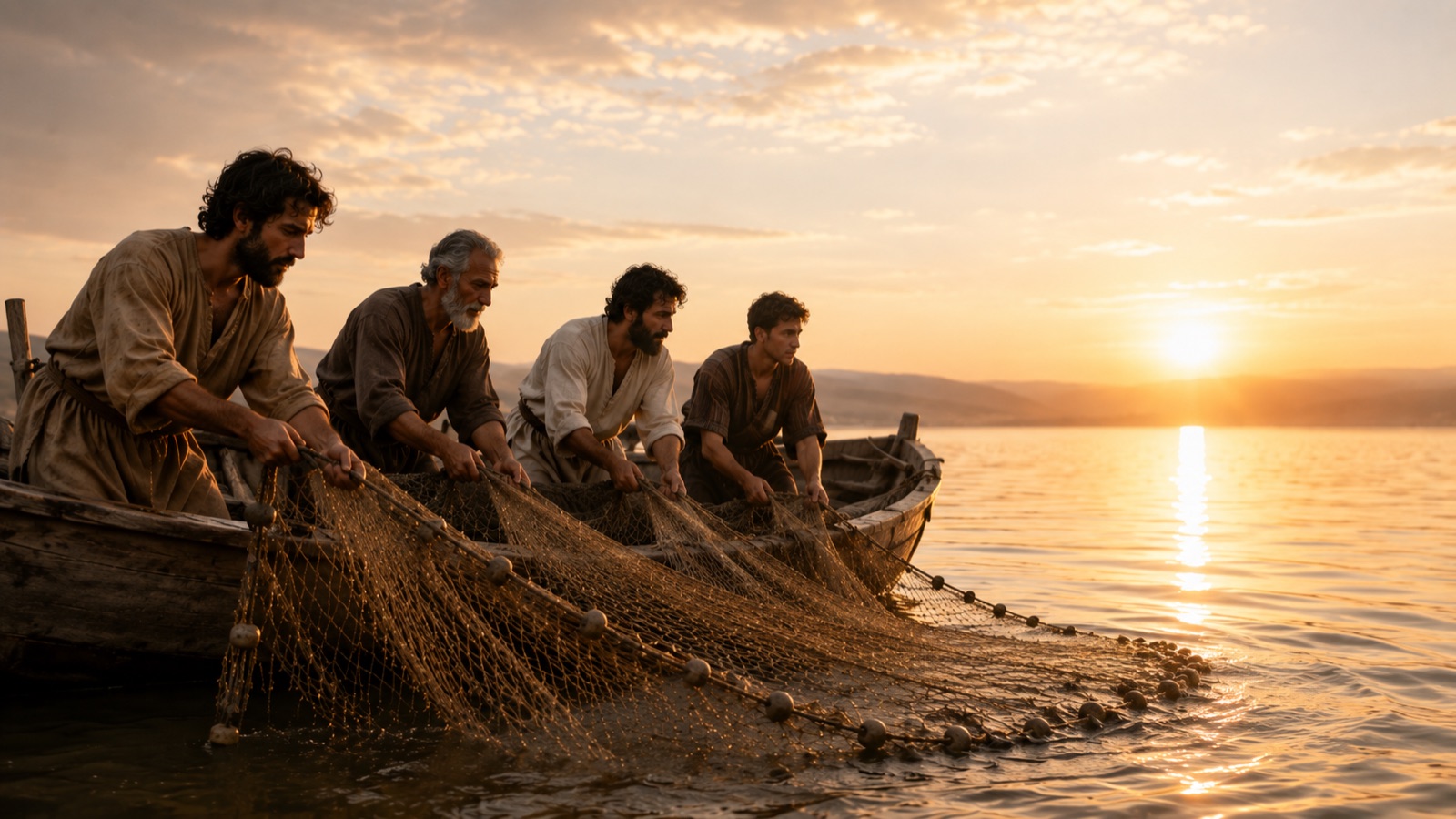
Peter was a fisherman before he was an apostle, and the Lord met him at his trade. "Master," he said, "we have toiled all the night, and have taken nothing: nevertheless at thy word I will let down the net" (Luke 5:5). They had worked the water hard and come up empty. Not because they were lazy, and not because there were no fish in the sea of Galilee — but because the net was down in the wrong water. When Christ told them where to cast, the catch nearly broke the nets.
No fisherman drops his line where he knows there are no fish. He goes where the fish are. He learns the water, the season, the time of day. And the Lord, who called these men to be fishers of men, did not abolish that wisdom — He baptized it. "Follow me, and I will make you fishers of men" (Matthew 4:19).
A church website is a net. And the question every pastor should ask about his is the same one Peter had to answer that morning: are we casting where the fish are, or are we toiling all night over empty water?
That is what search engine optimization really comes down to. Not tricks. Not gaming Google. Just the old fisherman's question, asked about the people in your town who are searching for something right now — and may not even know yet that Christ is the answer.
The fish are already searching
Here is the part that should stir a pastor's heart before we ever talk about strategy. The people in your community are not silent. Every day, right now, your neighbors are typing their questions, their fears, and their needs into a search box. They are searching for a church, yes — but they are also searching for the thing underneath the search.
A man whose marriage is falling apart types "is there hope for my marriage." A mother who just lost her own mother searches "how to deal with grief." A young father who hasn't darkened a church door in fifteen years quietly searches "good church for kids near me" because something in him wants better for his children than he had. Someone in the dark at two in the morning searches "what happens when you die."
These are not keywords. They are cries. And a search engine is, in a strange providence, one of the most honest places a person ever speaks — because they think no one is listening. They will type into Google what they would never say out loud in the pew.
Notice what this means. The hunger is already there. We do not manufacture it, and we could not if we tried — every one of those searches is a soul already hungry and thirsty for something it cannot name. The fishermen did not make the fish hungry; they only knew where the hungry fish were feeding. And this is exactly the hunger the Lord called to. "Ho, every one that thirsteth, come ye to the waters" (Isaiah 55:1). "If any man thirst, let him come unto me, and drink" (John 7:37). "Blessed are they which do hunger and thirst after righteousness: for they shall be filled" (Matthew 5:6). Christ did not call the comfortable and the full — He called the hungry, the thirsty, the labouring and heavy laden. Your neighbors typing in the dark are those very people. They are hungry, and they are searching for bread, and you have it.
The work of keyword targeting begins here: not with a tool, but with a question. What are the people the Lord has placed around your church actually searching for — and what is Christ the answer to? Map those two lists against each other, and you have found your fishing water.
Not all water holds fish
Now to the part fishermen understand instinctively and websites often miss. Not every word is worth casting over. Some water looks promising and holds nothing for you.
In SEO this is called keyword value, and it has two parts that pastors should hold together: how many people search a word, and whether they are your fish.
Consider Grace Baptist Church in Raleigh, North Carolina — a made-up example I'll use to keep this concrete; picture your own church in its place. Grace Baptist could try to rank for the word "church." Enormous numbers of people search it. But it is empty water for a small church in Raleigh — you are competing with the entire world, and most of the people typing that one word are nowhere near North Carolina and have no intention of visiting you. All net, no catch.
Three kinds of water tend to disappoint:
- The ocean nobody owns. Single broad words like "faith," "Bible," or "prayer" are searched by millions, which means everyone is fishing there and a local church will never be seen. Too big to win.
- The empty pond. Insider language only your members would type — your ministry's clever name, a program acronym, the title of a sermon series. Nobody outside your walls is searching it, so the page sits unseen. No fish to begin with.
- The wrong fish. Words that bring traffic but not your neighbors — someone in another state, a researcher, a person who'll never set foot in Raleigh. A bite, but nothing you can bring into the boat.
The good water is the third thing, and it is where targeting lives.
Casting on the right side of the ship
Remember the second great fishing miracle, after the resurrection. The disciples had fished all night and caught nothing — again. Jesus stood on the shore and said, "Cast the net on the right side of the ship, and ye shall find" (John 21:6). The same lake, the same net, the same men. The only difference was a few yards and a word from the Lord. And they could not draw the net for the multitude of fishes.
Targeting is casting on the right side of the ship. For Grace Baptist Church, the right water is not "church" — it is the searches that are big enough to matter, small enough to win, and full of the people who could actually walk through the doors:
- baptist church in Raleigh NC
- baptist church near me
- bible-believing church Raleigh NC
- family church Raleigh NC
- good church for kids Raleigh
- sunday school Raleigh NC
- what to expect visiting a church
- christian counseling for grief Raleigh
- church that helps with addiction Raleigh NC
Notice what these have in common. They name a place — Raleigh, "near me" — so the fish are local. They name a need — kids, grief, what to expect — so you know what the person is carrying. And they are specific enough that a faithful local church can actually rise to the top of the results, rather than drowning beneath the megachurches and national ministries.
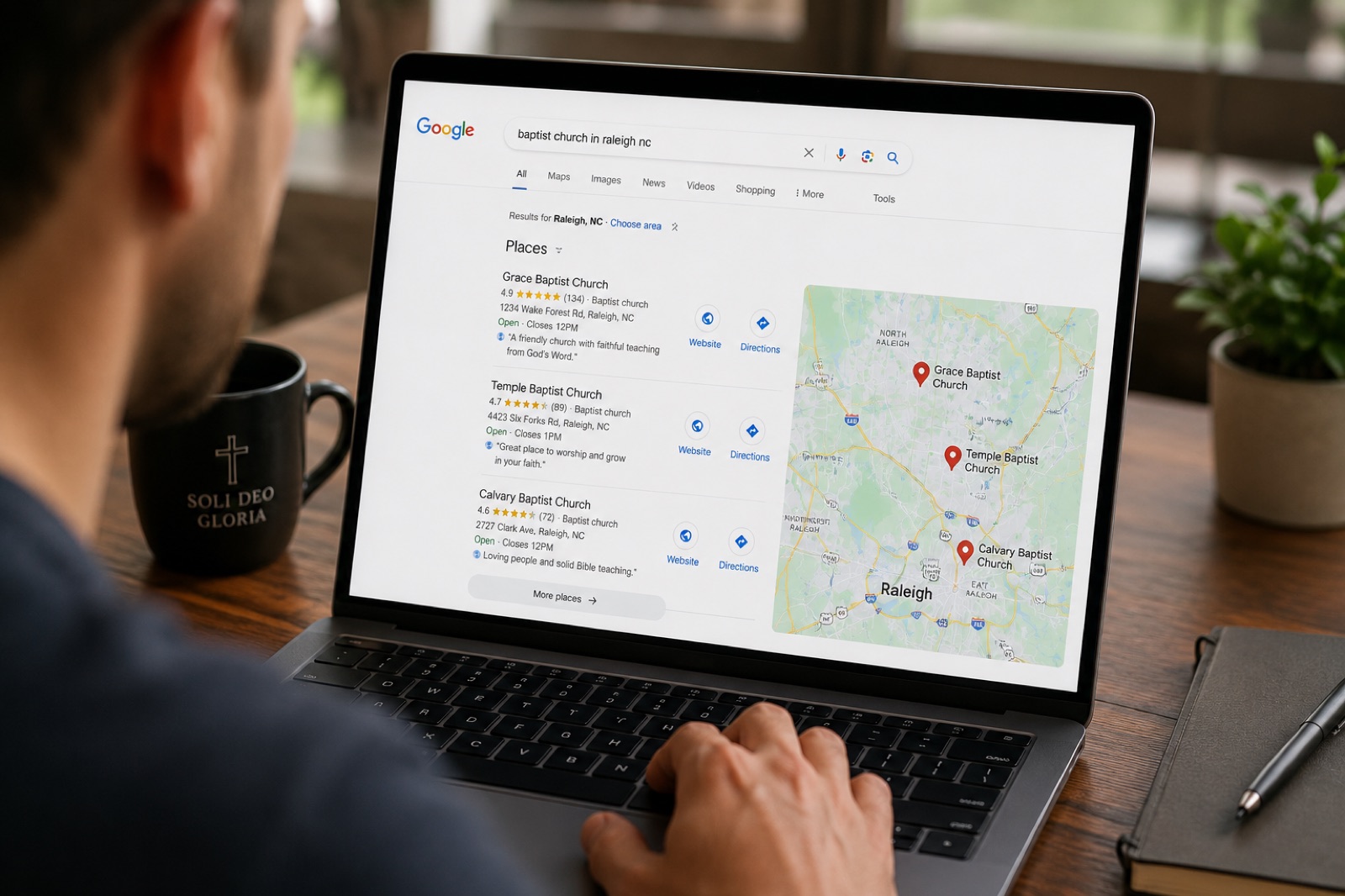
In the trade these longer, specific phrases are called long-tail keywords, and they are the church's best friend. Fewer people search "good church for kids in north Raleigh" than search "church" — but the handful who do are nearly standing in your parking lot already. A smaller net in the right water beats a vast net dragged through the open sea.
A free tool like Google's Keyword Planner will put real numbers to this, and they tell a clear story. The phrase "churches near me" is searched somewhere between ten thousand and a hundred thousand times a month — and the planner rates the competition for it as low. "baptist church near me" is searched a tenth as often, between one and ten thousand times — also low competition. Read those two lines like a fisherman reads the water and three things stand out. First, far more people search for a church generally ("near me") than name a denomination, so a page that only ever says "Baptist" is fishing a smaller pool than it could — you want both the broad "church near me" and the specific "Baptist church near me" working for you. Second, low competition means this is not the ocean nobody can win; a faithful local church can genuinely rise here. And third — a word of warning — the planner will also spit back garbled suggestions like "churches in near me" or "church near near me." No human being types those. They are noise, not water. Take the clean phrases real people actually search and leave the gibberish on the bank.
When do people need a church?
Here is the simplest way to find the biggest searches: stop thinking about keywords for a minute and ask a plain question. When does a person actually need a church?
Most people do not think about church on an ordinary Tuesday. They go about their week. But there are certain moments in a life when a person suddenly reaches for one — and in our day, the first place they reach is the phone in their pocket.
People look for a church when:
- Someone they love dies. They need a funeral, and they need comfort. They search "funeral service near me," "how to deal with grief," "what happens when you die."
- They are getting married. They search "church wedding near me," "pastor to marry us," "premarital counseling."
- A baby comes. Something about a new child makes a young couple want to raise that child better than they were raised — to give them God and a church home from the start. They search "baby dedication," "good church for kids near me," "churches with nursery near me."
- A marriage is falling apart. They search "marriage counseling near me," "is there hope for my marriage," "christian counseling."
- They hit bottom. Drinking, addiction, debt, despair. They search "addiction help near me," "celebrate recovery," "food pantry near me."
- They move to a new town. They had a church before and want one again. They search "churches near me," "baptist church near me."
- Their kids start growing up. They want them to know God before it's too late. They search "youth group near me," "Sunday school," "VBS near me."
- The holidays come around. Something stirs at Christmas and Easter that doesn't stir the rest of the year. They search "Christmas Eve service near me," "Easter service near me."
- They are afraid, or sick, or can't sleep. They search "bible verses about anxiety," "prayer for healing," "how to pray."
Every one of those is a real person at a real crossroads. And every one of those moments is also a search — a big one, searched by thousands of people every month. The widow, the new father, the man at the end of his rope: they are all typing.
So the biggest, most worthwhile searches for your church are simply the moments when people need what the church has. You are not chasing traffic. You are meeting people at the door they're already knocking on.
Two simple cautions before we go on.
First, the holiday searches are the largest of all — Easter and Christmas bring people who darken a church door only once or twice a year. But they only help if your page is ready before the day comes, not after. Build the Easter page in February, not in April.
Second, a few of these — "what happens when you die," "bible verses about anxiety," "how to pray" — are searched by enormous numbers of people all over the world, not just your town. Answering them on your website is good and worthy work; it reaches souls. But understand that most of those people will never visit your building. Those searches reach the lost far away. The ones that fill your own pews are the local ones — the moments that happen to people who live near enough to come on Sunday.
What the fish are carrying when they search
Here is where keyword work stops being mechanical and starts being pastoral. Behind every search is not just a topic but an intent — a reason the person reached for their phone. SEO people call it search intent. A shepherd would call it the burden the sheep is carrying.
The same five words can hide very different hearts. "Baptist church near me" might be a faithful family that just moved to town and wants a church home by Sunday. It might be a prodigal feeling the first tug toward the Father's house. It might be a grieving widow who hasn't been to church since the funeral and can't say why she's looking. Your website cannot read hearts — but it can be ready for all of them, because it knows what they are likely searching and meets each one with the truth.
So sort your words by what the person is living through:
- "Where and when do I go?" — service times, directions, "baptist church near me," "what to expect." These are the practical, ready-to-visit searches. The page should answer fast and warmly.
- "What do you believe?" — "bible-believing church," "what does the Baptist church teach," "King James church near me." These are people checking whether you preach the truth before they trust you with a Sunday morning. Be clear and unashamed.
- "I'm hurting, can you help?" — grief, marriage, addiction, anxiety, loneliness, "is there hope." These are the deep-water searches, and they are the ones where Christ is most plainly the answer. A church that addresses them honestly on its website is preaching the gospel to people who are quietly desperate to hear it.
When you build a page around one of these searches, you are not chasing traffic. You are standing on the shore where you know a hungry man will walk by, with bread already in your hand.
Make the page worth the catch
Knowing the water is half the work. The other half is what happens the moment the fish finds you. It does a church no good to rank first for "good church for kids in Raleigh" and then hand the visitor a thin page that never mentions children, never names the city, and never points them to the next step. The net pulls them in and the page lets them slip back out.
So once you've chosen a word to target, let it shape the page honestly:
- Put the search in the title. If you want to be found for children's ministry in Raleigh, the page title should say Children's Ministry at Grace Baptist Church in Raleigh, NC — not just "Kids." The fish should know they've found the right water before they even click.
- Answer the real question the search was asking. A page targeting "what to expect visiting a church" should actually walk a nervous first-timer through the morning — where to park, what to wear, what happens with their children, how long the service runs.
- Speak to the burden, then point to Christ. A page that meets grief, or marriage trouble, or addiction should name the pain plainly and then do what only the church can do — point the searcher to the Savior, and invite them to come.
- Always give the next step. Every page should make it easy to plan a visit, find a service time, or reach a real person. The net is no good without the boat.
One word of warning, because integrity is part of the witness. Target only words that are true of your church. Do not stuff a page with "addiction recovery" if you have no ministry that helps. Do not promise a vibrant youth group you do not have. The goal is never to trick a search engine into sending you people you cannot serve. That is bait, not a net, and it dishonors the One whose name is over the door. Cast honestly, and the fish you catch will be the ones the Lord meant for you.
How to find your water
You do not need to be an expert, and you do not need to guess. There are simple, free ways to learn what your own community is searching.
- Listen to your people first. What did your last few first-time visitors say when you asked how they found you, or what they'd been looking for? Those are real searches from real fish. Write them down.
- Watch Google's own suggestions. Begin typing "baptist church" or "church in [your city]" into the search box and notice what Google completes for you. Those suggestions are built from what real people search. The same goes for the "People also ask" and "Related searches" sections on a results page.
- Use a free keyword tool. Google's own Keyword Planner will show you roughly how often a phrase is searched and how much competition it carries — enough to tell an ocean from a pond from good fishing water.
- Notice the seasons. Fishermen know the runs. Searches for "Easter service near me," "vacation Bible school," and "Christmas Eve service" rise and fall every year like clockwork. Have those pages ready before the run starts, not after it's passed.
I wrote a companion piece, Helping Local Families Find Your Church, that walks through the nuts and bolts — claiming your listing, page titles, descriptions, and improving one page at a time. Think of this article as choosing where to fish, and that one as mending and setting the net once you know the water.
He gives the increase
Let me end where a pastor must end, lest any of this be mistaken for a confidence in technique. Paul planted, Apollos watered, "but God gave the increase" (1 Corinthians 3:6). You can study the water, choose your words with care, and cast the net on the right side of the ship — and still, no soul is saved by good keywords. The increase is the Lord's alone.
But that is no argument for carelessness. Peter still had to let down the net. The disciples still had to drag it to shore. The Lord works through means, and in our day a church website is one of the means by which a searching neighbor first hears that there is a church that loves them and a Savior who died for them. To leave that net carelessly thrown — over empty water, far from the fish, while souls within a mile of your steeple search and find nothing — is to toil all night for no reason.
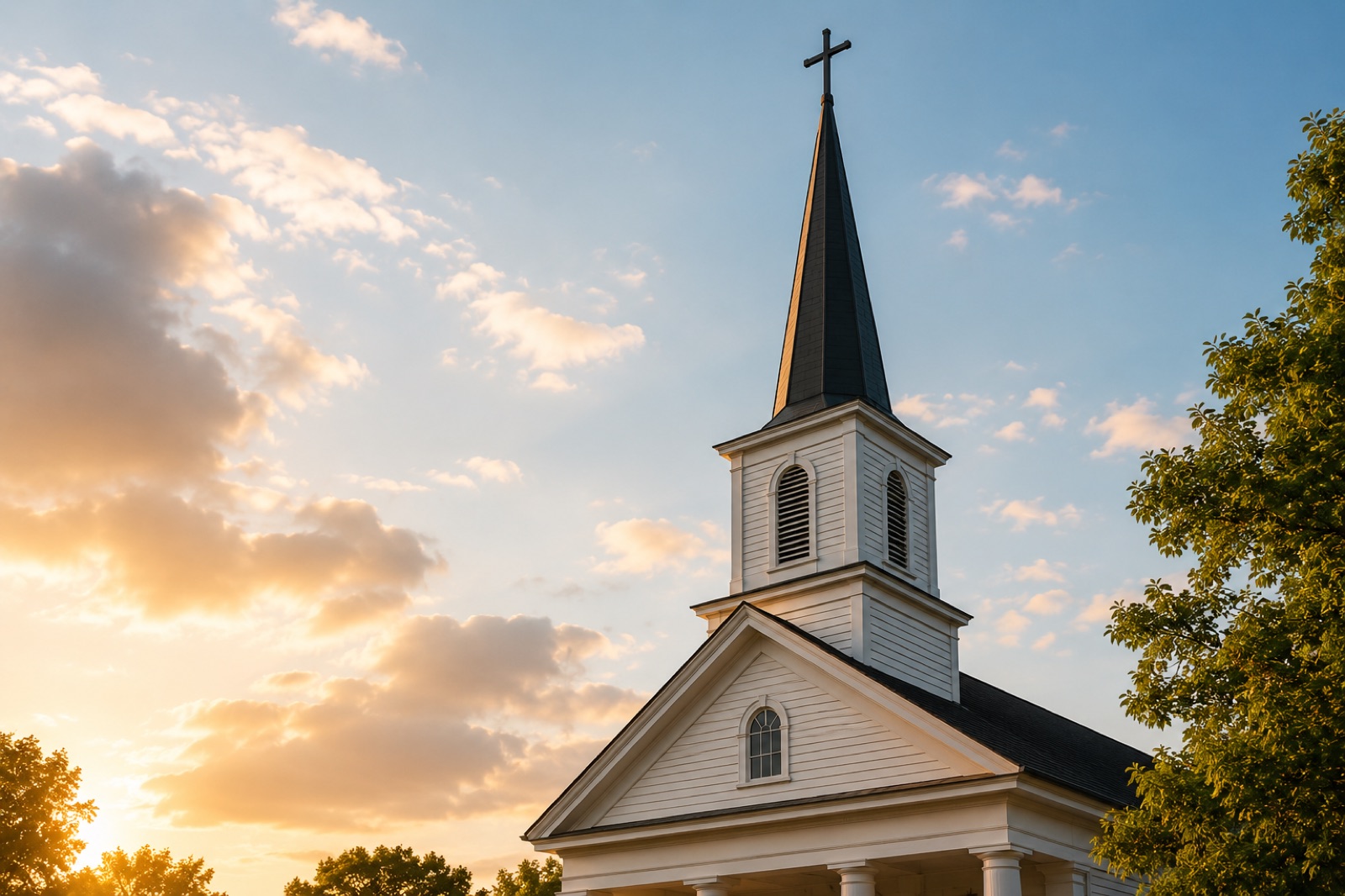
Think for a moment about why our fathers put steeples on churches at all. A steeple was never decoration. It was built to rise above every rooftop in town so that a traveler, a stranger, a wandering soul could lift his eyes from anywhere and know — there is the house of God. The bell in it rang out across the fields and called the whole community to come and worship. The steeple was a church's way of being found. It said, to everyone within sight and sound, here we are; come. For two hundred years it was the most far-reaching thing a congregation owned.
But people no longer lift their eyes to the skyline to find a church. They look down, at the phone in their hand. The search result is the steeple of our day — the place where a searching neighbor lifts his eyes and sees that there is a church near him. A church that never thought about how it shows up in search has, in effect, taken down its steeple and wondered why no one comes. Building your website to be found is nothing more than raising the steeple again, in the place where people are actually looking.
So learn the water. Find out what your neighbors are searching, and what they are carrying when they search it. Cast where the fish are. And then trust the One who called you to this trade to fill the nets.
"And he saith unto them, Follow me, and I will make you fishers of men." — Matthew 4:19