There's a moment in most church website projects when the pastor realizes they've hired the wrong person. It usually comes about four months in. The site is live, it looks fine, and the pastor emails to ask for the Christmas Eve service times to be added. The answer comes back in nine days, with an invoice.
Nothing about that designer's portfolio would have warned you. The questions you ask before you sign would have.
I'm a church website designer, so I'm writing about my own trade, and you should read this knowing that. I've tried to write the guide I'd want a pastor to read before hiring anyone, me included. The printable checklist at the end has the twenty questions with space to write the answers.
What a church website designer actually does
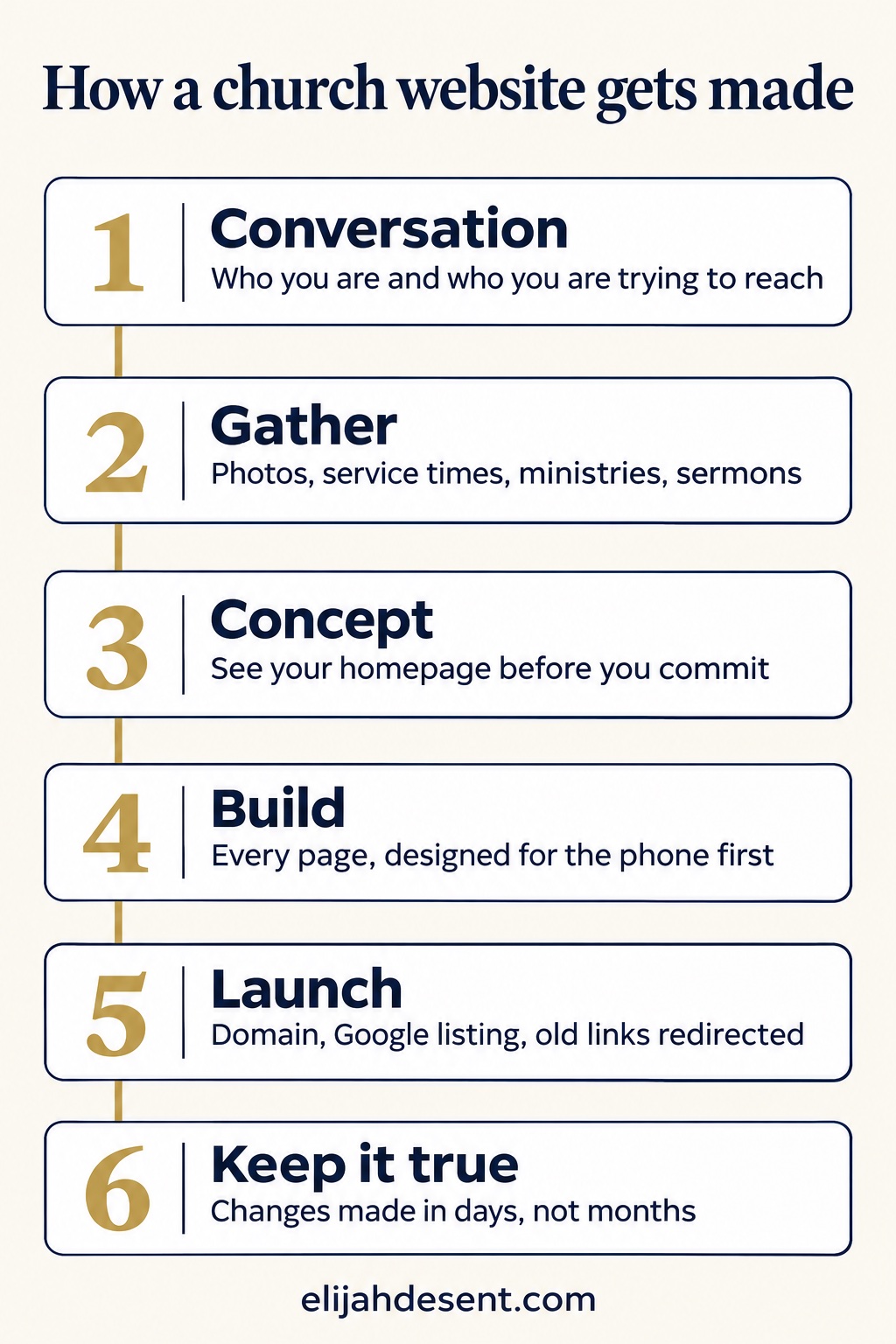
A website builder hands you a tool. A designer hands you a finished site and, ideally, keeps it that way. In between, a good church website designer will:
- Plan the pages around the person you're trying to reach, usually a nervous first-time guest on a phone.
- Write or tighten the words. Most church websites have too many words, and the important ones are buried.
- Choose and prepare the photos, which means real pictures of your people, sized so the site loads fast.
- Design for the phone first, since that's where most of your visitors will be.
- Build it, connect your domain, set up your Google listing, and redirect your old pages so nobody hits a dead link.
- Keep it current. This is the part most designers price as an afterthought, and it's the part that decides whether the site is still any good a year from now.
Designer, company, or agency?
Three kinds of people will offer to build your church's website, and they're right for different churches.
- An independent designer is one person, or a very small team. You talk to the person doing the work. Typically $1,500 to $5,000 for the design and $25 to $150 a month afterward, with launch in two to six weeks. This is the right fit for most churches under about five hundred people.
- A church website design company has a sales team, a project manager, and usually its own platform. It's more predictable and less personal. I've compared fourteen of them in Best Church Website Design Companies.
- An agency builds large, custom sites for large churches: $5,000 to $25,000 and up, eight to sixteen weeks, with a staff that expects to work with your communications director. If you don't have a communications director, you probably don't need an agency.
For the full cost picture, including the costs after the first year, see How Much Does a Church Website Cost?
Where to find a good one
The best church website designers rarely buy ads. Here's where to look instead.
- Find church sites you like, and scroll to the bottom. Most designers put a small credit in the footer. Find three church sites you'd be proud of, on your phone, and see who built them.
- Ask pastors you trust. Ask the follow-up too: how fast do they make changes? A pastor who loves the site but waits two weeks for an edit is telling you something.
- Ask your association or denomination. Many have a designer they've used before. Treat it as a lead, not an endorsement.
- Look at the designer's own live work, not their portfolio. A portfolio is curated screenshots. Ask for links to ten live sites and open them on your phone. Are the events current? Do the pages load fast? A designer's old sites tell you what yours will look like in two years.
Six red flags
Any one of these should end the conversation, or at least slow it way down.
- They'll register the domain "for you." In their name, on their account. This is the single most expensive mistake a church can make online, and it's surprisingly common. The domain is the church's. Full stop.
- They guarantee Google rankings. Nobody can. A guarantee is usually written around a search phrase nobody types.
- They can't show you live sites. Only screenshots, or only sites that have since been taken down.
- There's no plan for changes. "Just email us" is not a plan. You want a turnaround time and a price.
- The photos in their samples are all stock. If every church in their portfolio is the same smiling, diverse group of models, they'll do the same to you.
- They can't explain what you'll own if you leave. A fair answer can be "your words and photos, not the design." A vague answer is not fair.
The twenty questions
Ask these on the first call. Write the answers down. The ones in bold are the ones I'd never skip.
Ownership
- Who will own the domain name, and whose account will it be in?
- Who owns the design and the code when the site is done?
- If we part ways, what do we take with us, and how?
- Who has the login to the hosting, and can the church have one too?
Cost
- What's the total for year one, and what's the total for year two?
- What's included in the monthly fee, specifically?
- What costs extra? Pages, photos, forms, changes, a new section?
- Is there a contract, how long is it, and what does cancelling cost?
Changes after launch
- When we need a change, how do we ask, who does it, and how fast?
- Can we make simple changes ourselves, like times, events, or a photo, without breaking anything?
- What happens if you're sick, on vacation, or out of business?
The work
- Can we see a concept of our homepage before we commit?
- Can we see ten live church sites you built and still maintain?
- Will you write the words, or do we? Will you edit what we send?
- Will you use our real photos, and help us get better ones?
- How will it look and load on a phone over cellular data?
- How will people give, and what are the fees?
- Where will sermons live, and how will they get posted each week?
Getting found
- Will you set up or clean up our Google Business Profile and redirect our old pages?
- What will you do so a nearby family searching for a church on a Sunday morning can find us?
Download the 20 questions as a printable checklist (PDF)
What to bring to the first meeting
A designer can only build what you give them, and missing content is the reason most church website projects run late. Before the first call, gather:
- Service times and your full street address, written exactly as you want them to appear
- Ten to twenty recent photos of real people at your church, taken on a phone on a Sunday
- One paragraph about who your church is. Not your doctrinal statement, but what it's like to walk in.
- Staff names, roles, and a photo of each
- A list of ministries, with a contact person for each
- Where your sermons live now (YouTube, Facebook, a podcast)
- How people give now
- The login for your domain, or at least who registered it
Our free church website planning workbook walks through all of it, page by page.
Where I fit
I'm an independent church website designer. I'm a pastor, and I started building church websites because my own church needed one and then other pastors asked. I've now designed and built more than 300 church and ministry websites.
Here's how I'd answer the bolded questions. The church owns its domain. If you leave, you take your words, your photos, and your domain. Hosting and changes are $29 a month. You'll see a concept of your homepage before you pay anything. And changes take minutes rather than days, because I connect your finished site to ChatGPT or Claude so you can type the change yourself, in plain English, and the live site updates.
You can see live examples on my church website design page. Whether you hire me or not, ask every designer the same twenty questions and compare the answers side by side. The right person will be glad you asked.